Documents

Saturday, 3 February 2018

Transcendental Numbers

"...Pi wasn't the only transcendental number. In fact there was an infinity of transcendental numbers. More than that, there were more transcendental numbers than ordinary numbers, even though pi was the only one of them she had heard of. In more ways than one, pi was tied to infinity."

These beautiful lines are from the book, Contact by Carl Sagan.

Even though there are infinite transcendental numbers most of us have heard of only e and pi.
e = 2.718281828459045...
Pi = 3.1415926535...

Transcendental numbers are irrational. That is, they cannot be expressed as the ratio of two integers.

The abc book of e : mathwithbaddrawings.com

But all irrational numbers are not transcendental.
Its because, transcendental numbers cannot be expressed as a solution of a polynomial equation. In other words they are not the solution of any polynomial equation with integer coefficients.
So square root of 2 is an irrational number but not transcendental.


In this Numberphile video a simple proof is shown that pi is transcendental. The proof was given by Ferdinand von Lindemann in 1882.

1. He first proved that e^a is transcendental where a is nonzero. In 1873 Charles Hermite had already proved that e is transcendental.

2. Next, he used Roger Cotes' identity (famously but inaccurately known as Euler's identity). And using proof by contradiction he proved that i(pi) and pi are transcendental.

mathwithbaddrawings.com

There is a conjecture in transcendental theory which indirectly implies that above equation is the only nontrivial relation between e, pi and i.

Hilbert's seventh problem is also about transcendental numbers:

If a is an algebraic number such that a>1 and b is an irrational algebraic number, is a^b necessarily transcendental?

It was eventually proved and now known as Gelfond-Schrieder theorem in 1934.

Here are some of the numbers and functions that are proved to be transcendental.


Sunday, 28 January 2018

Charge Coupled Device and Astronomy

This post is about Charge Coupled Device or CCD and how it changed Astronomy.

The concept of CCD was invented by Willard S. Boyle and George E. Smith at Bell Telephone Laboratories.

In their lab notebook, on 19 October, 1969 they developed the idea of a memory device which they named as 'Charge Bubble Device' because it was an electronic analog of magnetic bubble device.
And few weeks later a device was designed, fabricated and tested.

Charge Coupled Device is now used in digital cameras and Smartphones as an image sensor. 

The functioning of a CCD can be divided in two phases-


1. Exposure – CCD is made of lots of individual pixels which collect light. Each of these pixels is actually a photodiode that converts light into electricity. When light falls on a pixel a free electron is released. If there are lots of electrons in a pixel it means there were lots of photons which hit the pixel. The amount of time till the shutter remains open is called the exposure time. In astronomy many exposures are taken with the CCD shutter closed and open. The dark frame average image is then subtracted from the open shutter image to remove dark current and other factors.

2. Readout – The electrons thus accumulated in each pixel are read out or counted electronically. In this process the electrons are shifted along the semiconductor surface from one storage capacitor to another and thus the information is stored. During the shifting process pixels continue to collect light. So the shifting process should be fast otherwise light may fall on a pixel already containing a charge. And it can lead to Vertical Smear which is a vertical bright line that extends from a bright source. During the readout time CCD cannot collect light. Only when all the electrons are counted the CCD again becomes ready to accumulate another set of electrons for the new image.


The digital cameras are described by the number of pixels they contain. CCD cameras can have pixels in multiple of one million. An M×N pixel camera tells us the number of rows (M) and columns (N) in a CCD. 

So a 1 megapixel camera with square shaped CCD will have 1024×1024 pixels.


It’s very interesting to notice that even before the concept of CCD was invented, NASA planned some projects which required an electronic solid state detector.
One of the project proposed in 1965 was, Large Space Telescope which was later called Hubble Space Telescope.

And the first Wide field Planetary Camera (WF/PC) in Hubble Space Telescope used 8 Texas Instruments backside-illuminated 800×800×15 mu meter pixel three-phase CCDs.

Here the backside illumination is the technique used in CCDs. In this, the image is focused on the back side of Silicon so that the maximum amount of photons are detected. But for this the thick wafer on which CCD is built must be very thin.


The CCD used in ACS (Advanced Camera for Surveys) - www.spacetelescope.org

The WF/PC produced many beautiful images. And it was replaced by WF/PC 2 in December, 1993.


Astronauts installing the WFC 3 


The second generation WF/PC 2 camera system with corrective optics had four Lockheed frontside-illuminated 800×800×15 mu meter pixel three-phase CCDs. Then a new camera named ACS (Advanced Camera for Surveys) was installed in 2002. And it was also replaced in 2009 by WFC 3.

spacetelescope.org : A gravitational lens captured by WF/PC 2


WF/PC 2

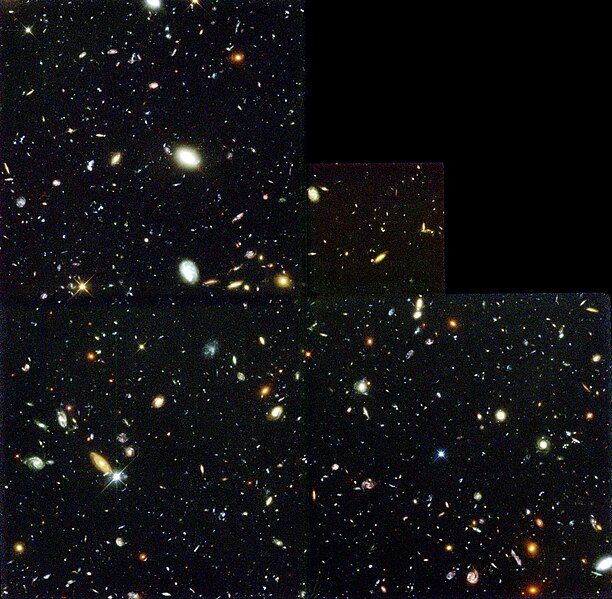
Out of all the images taken with the cameras installed in Hubble Space Telescope, the deepest view of the universe was provided with the Hubble Deep Field images.


The first Hubble Deep Field image was captured with three WF/PC 2 CCD detectors. Separate images in blue, red and infrared were captured to make the true-color image.


After many such Deep Field images, Hubble Ultra Deep Field image was taken with the Advanced Camera for Surveys (ACS) in the Fornax constellation. In 2009 Hubble Ultra Deep Field (HUDF) was taken with the Wide Field Camera 3 in infrared. Later in 2012 Hubble eXtreem Deep Field was released which was just the combination of many exposures of UDF. 

The last HUDF was released in 2014. It’s a composite image of the exposures taken from 2002 to 2012 with the Advanced Camera for Surveys and Wide Field Camera 3 of Hubble Space Telescope. The project was called the Ultraviolet coverage of the Hubble Ultra Deep Field (UVUDF).

> You can see what Hubble Space Telescope is observing right now with WFC 3. 

   Spacetelescopelive.org


Saturday, 20 January 2018

Apparent Size

One of the units used in astronomy is degree.

1 degree = 1/360 of a circle
1 arc minute = 1' = 1/60 of a degree
1 arc second = 1'' = 1/60 of an arcminute

The size of a planet or other astronomical objects is described using their angular diameter as seen from Earth, or simply their apparent size.

And apparent size is the angle subtended by an object which is usually measured in degrees, arcminutes or arcseconds.

Sun and Moon appear similar as seen from earth so their apparent size is almost same, 1/2 degree.

Another interesting example is the Hubble deep field which is an image of a small region in the constellation Ursa Major (Big Dipper).

wikipedia.org

It covers an area of about 2.6 arcminutes. And the image was taken with the Wide Field and Planetary Camera 2 of Hubble Space Telescope.  342 exposures were taken from 18 to 28 December, 1995.

wikipedia.org : Hubble Deep Field (1995)


Friday, 12 January 2018

Brightness of stars

One of the units used in Astronomy is Magnitude (or brightness). It tells us about the brightness of stars or other astronomical objects.

Magnitude is actually divided in two types, apparent and absolute.

1. Apparent Magnitude tells us how bright a star is as seen from Earth. And its inversely proportional to the square of distance.

The measurement of apparent brightness is called photometry.


Image Credit: www.windows2universe.org

If we assume that stars are at same distance from us then we can compare their brightness. And that's what absolute magnitude tells us.

2. Absolute Magnitude gives us the brightness of stars as seen from 10 parsecs (32.6 light years).

Greek Astronomer Hipparchus categorized the stars according to their brightness more than 2000 years ago. According to him the brightest stars were of first magnitude and faintest were of sixth magnitude.
The first magnitude stars were two times brighter than second magnitude stars.

Later, as the instruments became more sensitive, astronomers found that the magnitude scale was not accurate.
But instead of abandoning it, they refined it.

In the Modern Magnitude System, first magnitude stars are about 2.512 times brighter than second magnitude stars. And second magnitude stars are (2.512)^2 times brighter than third magnitude stars.

So faint stars have bigger magnitude.

https://en.m.wikipedia.org/wiki/Luminosity

For example let's take two stars of Orion constellation, Rigel and Betelgeuse.

1. Rigel
    Apparent magnitude (m) = +0.12
2. Betelgeuse
    m = +0.50
The difference between their magnitude is
0.50 - 0.12 = 0.38

So Rigel is about (2.512)^0.38 times brighter (apparent brightness) than Betelgeuse.

Absolute magnitude, apparent magnitude and distance are interrelated. So if two are known, another can be calculated.

To study brightest stars (as seen from Earth) BRITE (BRIght Target Explorer) a set of 6 nano satellites were launched in 2013.

www.brite-constellation.at

Out of six, two satellites UniBRITE-1 and TUGSAT-1 (BRITE-Austria) were launched by PSLVC-20 on February 25, 2013 from ISRO's Satish Dhawan Space Centre, Sriharikota, Andhra Pradesh.

Image credit : ww.isro.gov.in


Wednesday, 10 January 2018

ARIES

This New Year I would like to share some of the best astronomical memories.

The first visit to ARIES (Aryabhatta Instititue of Obervational Sciences) in September 2016 will always be memorable. I had never imagined the place to be so serene and filled with loads of beautiful flowers and trees covered with lavish green mosses, and lichens.


The most beautiful experience was when I saw Professor Hum Chand who is a Scientist at ARIES working alone in front of a computer with soft background music. His room was filled with loads of files and papers. It was the first time I saw the Lab of a scientist.

It was also a thrilling experience for me and my sister to see the 104cm Sampurnanand Telescope, a 40 year old telescope at ARIES. 


The dome of 104cm Telescope at ARIES : aries.res.in

There are other telescopes at ARIES like the 130 cm telescope at Devasthal and the newly installed 3.6 m Optical Telescope which is the largest optical telescope in Asia.

The 3.6 m Devasthal Optical Telescope : aries.res.in


And actually it was not the first time that I met Professor Chand. Two years ago in 2014, I attended his talk “Wonders of our Universe” in the seminar held in our college.


A small model of the 3.6 m Devasthal Optical Telescope (DOT) in the Seminar

HoD Physics Professor  L.P.Verma, who organised this grand seminar is giving the talk on Solar Flares which was also the topic of  his research work during his PhD.

After him Professor Brijesh kumar who is also a scientist at ARIES told us about the new 3.6m Devasthal Optical Telescope being installed. I also remember asking him a question which more-or-less was, “When the new telescope will be fully installed what you will see first”.
 And he answered that we do not see things but observe them and according to the project proposals, scientists will be observing lots of things like binary stars, planets beyond our solar system etc.
Next day one of the talks in seminar was given by another scientist of ARIES Professor Yogesh Joshi. He talked about “Looking for Planets beyond Solar System

It was a really amazing experience to listen to so many scientists and professors. I also made a report and wrote about almost every speaker and their talks.

The same year I built a small Galilean telescope. The most amazing experience was when we saw more stars in the Pleiades star cluster and In the Orion constellation than could be seen with naked eye. I could also see the craters on the moon which to normal eye appears just a white orb in the sky.


My younger sister observing the last Supermoon of 2017. 

I was fortunate to visit ARIES the second time in March 2017 with mommy and my younger sister. This time I met other scientists and PhD students. And I was able to talk to Professor Biman who is a scientist there.


And I hope in future I will meet more scientists and people working in the field of Astronomical Sciences.


Friday, 22 December 2017

Snowflakes

Snowflakes are really awesome, and I realized it when I first saw these amazing pictures by Alexey Kljatov.


The size of these snowflakes is only a few millimeters!

We can make paper snowflakes or kind of snowflakes as shown in this 5 year old video by Vihart. 


I also tried to make some patterns. Not all them were perfect but I made some good ones also! 


Snowflakes have sixfold symmetry that is if you rotate a snowflake by 60 degrees it will look the same as before. 
Here is a paper snowflake with sixfold symmetry!


Happy Mathematics Day!


Sunday, 10 December 2017

Mathematics Day

To celebrate the birthday of the famous mathematician Shrinivas Ramanujam or Mathematics Day (22nd December), I would like to share some interesting stuff,

First of all this year, Ramanujam's birth date is more special because 22-12-2017 is a prime number! And it would have been his 130th birthday.


What is shown here is a Magic square. It is an n×n array whose row, column and the diagonal numbers add up to the same number.

The magic square shown above was made by Ramanujam. Its very first row contains his Birth Date. So its also known as Ramanujam's magic square.

If you add the numbers along the row, column or along the diagonal they will add up to 139 (a prime number).