Documents

Saturday, 3 March 2018

3. XMM-Newton

XMM-Newton is a space telescope that is orbiting around Earth in an elliptical orbit of 48 hours.

Artistic Image of XMM-Newton - ESA - D. Ducros

It was launched on December 10, 1999.  
Later on February 9, 2000 European Space Agency (ESA) presented the first image taken by XMM and also announced its new name : XMM-Newton after the originator of the field of spectroscopy - Issac Newton. It's now called X-ray Multi-Mirror mission. One of its goals was to identify black hole candidates. 

Some of its major instruments are-
1. European Photon Imaging Cameras (EPIC) : It has two MOS-CCD cameras of total resolution 2.5 MegaPixel to detect low energy X-rays and a single pn-CCD camera to detect high energy X-rays.
2. Reflection Grating Spectrometers (RGS)
3. Optical Monitor 

XMM-Newton and NASA's NuSTAR measured the spin rate of a Supermassive Black Hole for the first time which is at the center of galaxy NGC 1365.

Last year in December the mission was extended for two years and is expected to operate till the end of 2020.

Friday, 2 March 2018

2. Keck Telescopes

W.M. Keck Observatory has two Telescopes in the Hawaii Island which lies in the middle of the Pacific Ocean.

The red dot shows the position of Keck Telescopes on Earth

The two Keck telescopes can see both infrared and visible light. Each telescope has a diameter of 10m and weigh 300 tons. The mirror used is made of 36 Hexagonal segments and a single segment is 1.8m in diameter which is only a little bit greater than the average human height.

Keck Telescopes

Keck1 telescope started observing in May 1993 and Keck2 telescope in October 1996.

A recent science news released by Keck Observatory tells us about a star orbiting the supermassive black hole at the centre of our galaxy, which was thought to be binary. The star named S0-2 is now proved to be single.

The orbit of S0-2 is shown in blue in the image below.

CREDIT: S. SAKAI/A.GHEZ/W. M. KECK OBSERVATORY/ UCLA GALACTIC CENTER GROUP

There are several theories which describe how S0-2 can form near the black hole and the theory that S0-2 should be a binary is one of them.

But the news that S0-2 does not have a companion deepens the mystery of its formation.

Thursday, 1 March 2018

1. Very Large Telescope Array (VLT)

European Southern Observatory has advanced observational facilities at three sites in northern Chile - La Silla, Paranal and Chajnantor.

The red dot shows the position of VLT on Earth

Very Large Telescope (VLT) at Paranal has four 8.2m telescopes and four 1.8m telescopes.
These telescopes can work together to form a giant interferometer.
The 8.2m telescopes are mostly used individually but the 1.8m telescopes are available to allow VLTI to operate every night.

The large 8.2 telescopes are named Antu, Kueyen, Melipal, Yepun. Out of four Antu was the first telescope to begin routine observations from 1st April, 1999.

There are many discoveries and scientific firsts by VLT.

1. The accelerating expansion of the universe.

For this discovery Nobel Prize in physics was awarded in 2011. ESO's two observatories also contributed to the discovery and VLT was one of them.

Hubble's observation of red shifted galaxies led to the theory of expanding universe and the observation of Type1a Supernova led to the theory of accelerating expansion of the universe.

2. First image of an extrasolar planet.

3. Tracking of individual stars that are moving around Supermassive Black Hole at the center of Milky Way.

Saturday, 3 February 2018

Transcendental Numbers

"...Pi wasn't the only transcendental number. In fact there was an infinity of transcendental numbers. More than that, there were more transcendental numbers than ordinary numbers, even though pi was the only one of them she had heard of. In more ways than one, pi was tied to infinity."

These beautiful lines are from the book, Contact by Carl Sagan.

Even though there are infinite transcendental numbers most of us have heard of only e and pi.
e = 2.718281828459045...
Pi = 3.1415926535...

Transcendental numbers are irrational. That is, they cannot be expressed as the ratio of two integers.

The abc book of e : mathwithbaddrawings.com

But all irrational numbers are not transcendental.
Its because, transcendental numbers cannot be expressed as a solution of a polynomial equation. In other words they are not the solution of any polynomial equation with integer coefficients.
So square root of 2 is an irrational number but not transcendental.


In this Numberphile video a simple proof is shown that pi is transcendental. The proof was given by Ferdinand von Lindemann in 1882.

1. He first proved that e^a is transcendental where a is nonzero. In 1873 Charles Hermite had already proved that e is transcendental.

2. Next, he used Roger Cotes' identity (famously but inaccurately known as Euler's identity). And using proof by contradiction he proved that i(pi) and pi are transcendental.

mathwithbaddrawings.com

There is a conjecture in transcendental theory which indirectly implies that above equation is the only nontrivial relation between e, pi and i.

Hilbert's seventh problem is also about transcendental numbers:

If a is an algebraic number such that a>1 and b is an irrational algebraic number, is a^b necessarily transcendental?

It was eventually proved and now known as Gelfond-Schrieder theorem in 1934.

Here are some of the numbers and functions that are proved to be transcendental.


Sunday, 28 January 2018

Charge Coupled Device and Astronomy

This post is about Charge Coupled Device or CCD and how it changed Astronomy.

The concept of CCD was invented by Willard S. Boyle and George E. Smith at Bell Telephone Laboratories.

In their lab notebook, on 19 October, 1969 they developed the idea of a memory device which they named as 'Charge Bubble Device' because it was an electronic analog of magnetic bubble device.
And few weeks later a device was designed, fabricated and tested.

Charge Coupled Device is now used in digital cameras and Smartphones as an image sensor. 

The functioning of a CCD can be divided in two phases-


1. Exposure – CCD is made of lots of individual pixels which collect light. Each of these pixels is actually a photodiode that converts light into electricity. When light falls on a pixel a free electron is released. If there are lots of electrons in a pixel it means there were lots of photons which hit the pixel. The amount of time till the shutter remains open is called the exposure time. In astronomy many exposures are taken with the CCD shutter closed and open. The dark frame average image is then subtracted from the open shutter image to remove dark current and other factors.

2. Readout – The electrons thus accumulated in each pixel are read out or counted electronically. In this process the electrons are shifted along the semiconductor surface from one storage capacitor to another and thus the information is stored. During the shifting process pixels continue to collect light. So the shifting process should be fast otherwise light may fall on a pixel already containing a charge. And it can lead to Vertical Smear which is a vertical bright line that extends from a bright source. During the readout time CCD cannot collect light. Only when all the electrons are counted the CCD again becomes ready to accumulate another set of electrons for the new image.


The digital cameras are described by the number of pixels they contain. CCD cameras can have pixels in multiple of one million. An M×N pixel camera tells us the number of rows (M) and columns (N) in a CCD. 

So a 1 megapixel camera with square shaped CCD will have 1024×1024 pixels.


It’s very interesting to notice that even before the concept of CCD was invented, NASA planned some projects which required an electronic solid state detector.
One of the project proposed in 1965 was, Large Space Telescope which was later called Hubble Space Telescope.

And the first Wide field Planetary Camera (WF/PC) in Hubble Space Telescope used 8 Texas Instruments backside-illuminated 800×800×15 mu meter pixel three-phase CCDs.

Here the backside illumination is the technique used in CCDs. In this, the image is focused on the back side of Silicon so that the maximum amount of photons are detected. But for this the thick wafer on which CCD is built must be very thin.


The CCD used in ACS (Advanced Camera for Surveys) - www.spacetelescope.org

The WF/PC produced many beautiful images. And it was replaced by WF/PC 2 in December, 1993.


Astronauts installing the WFC 3 


The second generation WF/PC 2 camera system with corrective optics had four Lockheed frontside-illuminated 800×800×15 mu meter pixel three-phase CCDs. Then a new camera named ACS (Advanced Camera for Surveys) was installed in 2002. And it was also replaced in 2009 by WFC 3.

spacetelescope.org : A gravitational lens captured by WF/PC 2


WF/PC 2

Out of all the images taken with the cameras installed in Hubble Space Telescope, the deepest view of the universe was provided with the Hubble Deep Field images.


The first Hubble Deep Field image was captured with three WF/PC 2 CCD detectors. Separate images in blue, red and infrared were captured to make the true-color image.


After many such Deep Field images, Hubble Ultra Deep Field image was taken with the Advanced Camera for Surveys (ACS) in the Fornax constellation. In 2009 Hubble Ultra Deep Field (HUDF) was taken with the Wide Field Camera 3 in infrared. Later in 2012 Hubble eXtreem Deep Field was released which was just the combination of many exposures of UDF. 

The last HUDF was released in 2014. It’s a composite image of the exposures taken from 2002 to 2012 with the Advanced Camera for Surveys and Wide Field Camera 3 of Hubble Space Telescope. The project was called the Ultraviolet coverage of the Hubble Ultra Deep Field (UVUDF).

> You can see what Hubble Space Telescope is observing right now with WFC 3. 

   Spacetelescopelive.org


Saturday, 20 January 2018

Apparent Size

One of the units used in astronomy is degree.

1 degree = 1/360 of a circle
1 arc minute = 1' = 1/60 of a degree
1 arc second = 1'' = 1/60 of an arcminute

The size of a planet or other astronomical objects is described using their angular diameter as seen from Earth, or simply their apparent size.

And apparent size is the angle subtended by an object which is usually measured in degrees, arcminutes or arcseconds.

Sun and Moon appear similar as seen from earth so their apparent size is almost same, 1/2 degree.

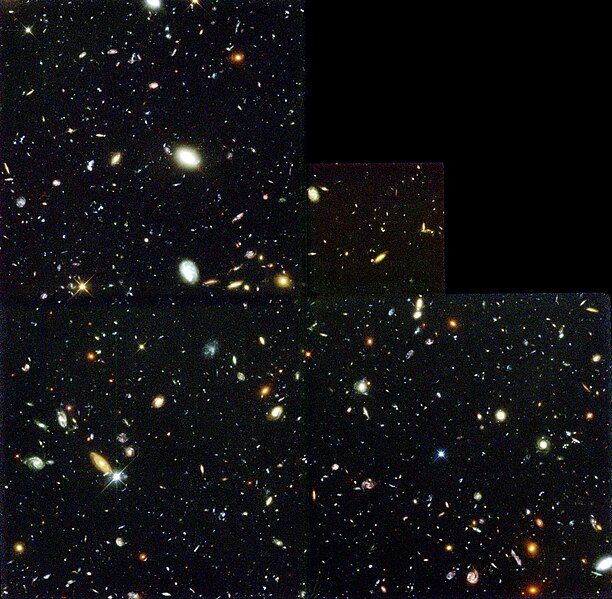
Another interesting example is the Hubble deep field which is an image of a small region in the constellation Ursa Major (Big Dipper).

wikipedia.org

It covers an area of about 2.6 arcminutes. And the image was taken with the Wide Field and Planetary Camera 2 of Hubble Space Telescope.  342 exposures were taken from 18 to 28 December, 1995.

wikipedia.org : Hubble Deep Field (1995)


Friday, 12 January 2018

Brightness of stars

One of the units used in Astronomy is Magnitude (or brightness). It tells us about the brightness of stars or other astronomical objects.

Magnitude is actually divided in two types, apparent and absolute.

1. Apparent Magnitude tells us how bright a star is as seen from Earth. And its inversely proportional to the square of distance.

The measurement of apparent brightness is called photometry.


Image Credit: www.windows2universe.org

If we assume that stars are at same distance from us then we can compare their brightness. And that's what absolute magnitude tells us.

2. Absolute Magnitude gives us the brightness of stars as seen from 10 parsecs (32.6 light years).

Greek Astronomer Hipparchus categorized the stars according to their brightness more than 2000 years ago. According to him the brightest stars were of first magnitude and faintest were of sixth magnitude.
The first magnitude stars were two times brighter than second magnitude stars.

Later, as the instruments became more sensitive, astronomers found that the magnitude scale was not accurate.
But instead of abandoning it, they refined it.

In the Modern Magnitude System, first magnitude stars are about 2.512 times brighter than second magnitude stars. And second magnitude stars are (2.512)^2 times brighter than third magnitude stars.

So faint stars have bigger magnitude.

https://en.m.wikipedia.org/wiki/Luminosity

For example let's take two stars of Orion constellation, Rigel and Betelgeuse.

1. Rigel
    Apparent magnitude (m) = +0.12
2. Betelgeuse
    m = +0.50
The difference between their magnitude is
0.50 - 0.12 = 0.38

So Rigel is about (2.512)^0.38 times brighter (apparent brightness) than Betelgeuse.

Absolute magnitude, apparent magnitude and distance are interrelated. So if two are known, another can be calculated.

To study brightest stars (as seen from Earth) BRITE (BRIght Target Explorer) a set of 6 nano satellites were launched in 2013.

www.brite-constellation.at

Out of six, two satellites UniBRITE-1 and TUGSAT-1 (BRITE-Austria) were launched by PSLVC-20 on February 25, 2013 from ISRO's Satish Dhawan Space Centre, Sriharikota, Andhra Pradesh.

Image credit : ww.isro.gov.in