Documents

Saturday, 20 January 2018

Apparent Size

One of the units used in astronomy is degree.

1 degree = 1/360 of a circle
1 arc minute = 1' = 1/60 of a degree
1 arc second = 1'' = 1/60 of an arcminute

The size of a planet or other astronomical objects is described using their angular diameter as seen from Earth, or simply their apparent size.

And apparent size is the angle subtended by an object which is usually measured in degrees, arcminutes or arcseconds.

Sun and Moon appear similar as seen from earth so their apparent size is almost same, 1/2 degree.

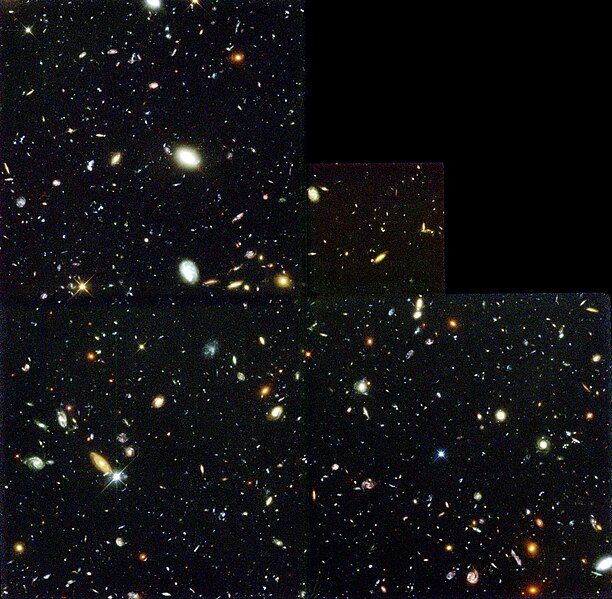
Another interesting example is the Hubble deep field which is an image of a small region in the constellation Ursa Major (Big Dipper).

wikipedia.org

It covers an area of about 2.6 arcminutes. And the image was taken with the Wide Field and Planetary Camera 2 of Hubble Space Telescope.  342 exposures were taken from 18 to 28 December, 1995.

wikipedia.org : Hubble Deep Field (1995)


Friday, 12 January 2018

Brightness of stars

One of the units used in Astronomy is Magnitude (or brightness). It tells us about the brightness of stars or other astronomical objects.

Magnitude is actually divided in two types, apparent and absolute.

1. Apparent Magnitude tells us how bright a star is as seen from Earth. And its inversely proportional to the square of distance.

The measurement of apparent brightness is called photometry.


Image Credit: www.windows2universe.org

If we assume that stars are at same distance from us then we can compare their brightness. And that's what absolute magnitude tells us.

2. Absolute Magnitude gives us the brightness of stars as seen from 10 parsecs (32.6 light years).

Greek Astronomer Hipparchus categorized the stars according to their brightness more than 2000 years ago. According to him the brightest stars were of first magnitude and faintest were of sixth magnitude.
The first magnitude stars were two times brighter than second magnitude stars.

Later, as the instruments became more sensitive, astronomers found that the magnitude scale was not accurate.
But instead of abandoning it, they refined it.

In the Modern Magnitude System, first magnitude stars are about 2.512 times brighter than second magnitude stars. And second magnitude stars are (2.512)^2 times brighter than third magnitude stars.

So faint stars have bigger magnitude.

https://en.m.wikipedia.org/wiki/Luminosity

For example let's take two stars of Orion constellation, Rigel and Betelgeuse.

1. Rigel
    Apparent magnitude (m) = +0.12
2. Betelgeuse
    m = +0.50
The difference between their magnitude is
0.50 - 0.12 = 0.38

So Rigel is about (2.512)^0.38 times brighter (apparent brightness) than Betelgeuse.

Absolute magnitude, apparent magnitude and distance are interrelated. So if two are known, another can be calculated.

To study brightest stars (as seen from Earth) BRITE (BRIght Target Explorer) a set of 6 nano satellites were launched in 2013.

www.brite-constellation.at

Out of six, two satellites UniBRITE-1 and TUGSAT-1 (BRITE-Austria) were launched by PSLVC-20 on February 25, 2013 from ISRO's Satish Dhawan Space Centre, Sriharikota, Andhra Pradesh.

Image credit : ww.isro.gov.in


Wednesday, 10 January 2018

ARIES

This New Year I would like to share some of the best astronomical memories.

The first visit to ARIES (Aryabhatta Instititue of Obervational Sciences) in September 2016 will always be memorable. I had never imagined the place to be so serene and filled with loads of beautiful flowers and trees covered with lavish green mosses, and lichens.


The most beautiful experience was when I saw Professor Hum Chand who is a Scientist at ARIES working alone in front of a computer with soft background music. His room was filled with loads of files and papers. It was the first time I saw the Lab of a scientist.

It was also a thrilling experience for me and my sister to see the 104cm Sampurnanand Telescope, a 40 year old telescope at ARIES. 


The dome of 104cm Telescope at ARIES : aries.res.in

There are other telescopes at ARIES like the 130 cm telescope at Devasthal and the newly installed 3.6 m Optical Telescope which is the largest optical telescope in Asia.

The 3.6 m Devasthal Optical Telescope : aries.res.in


And actually it was not the first time that I met Professor Chand. Two years ago in 2014, I attended his talk “Wonders of our Universe” in the seminar held in our college.


A small model of the 3.6 m Devasthal Optical Telescope (DOT) in the Seminar

HoD Physics Professor  L.P.Verma, who organised this grand seminar is giving the talk on Solar Flares which was also the topic of  his research work during his PhD.

After him Professor Brijesh kumar who is also a scientist at ARIES told us about the new 3.6m Devasthal Optical Telescope being installed. I also remember asking him a question which more-or-less was, “When the new telescope will be fully installed what you will see first”.
 And he answered that we do not see things but observe them and according to the project proposals, scientists will be observing lots of things like binary stars, planets beyond our solar system etc.
Next day one of the talks in seminar was given by another scientist of ARIES Professor Yogesh Joshi. He talked about “Looking for Planets beyond Solar System

It was a really amazing experience to listen to so many scientists and professors. I also made a report and wrote about almost every speaker and their talks.

The same year I built a small Galilean telescope. The most amazing experience was when we saw more stars in the Pleiades star cluster and In the Orion constellation than could be seen with naked eye. I could also see the craters on the moon which to normal eye appears just a white orb in the sky.


My younger sister observing the last Supermoon of 2017. 

I was fortunate to visit ARIES the second time in March 2017 with mommy and my younger sister. This time I met other scientists and PhD students. And I was able to talk to Professor Biman who is a scientist there.


And I hope in future I will meet more scientists and people working in the field of Astronomical Sciences.


Friday, 22 December 2017

Snowflakes

Snowflakes are really awesome, and I realized it when I first saw these amazing pictures by Alexey Kljatov.


The size of these snowflakes is only a few millimeters!

We can make paper snowflakes or kind of snowflakes as shown in this 5 year old video by Vihart. 


I also tried to make some patterns. Not all them were perfect but I made some good ones also! 


Snowflakes have sixfold symmetry that is if you rotate a snowflake by 60 degrees it will look the same as before. 
Here is a paper snowflake with sixfold symmetry!


Happy Mathematics Day!


Sunday, 10 December 2017

Mathematics Day

To celebrate the birthday of the famous mathematician Shrinivas Ramanujam or Mathematics Day (22nd December), I would like to share some interesting stuff,

First of all this year, Ramanujam's birth date is more special because 22-12-2017 is a prime number! And it would have been his 130th birthday.


What is shown here is a Magic square. It is an n×n array whose row, column and the diagonal numbers add up to the same number.

The magic square shown above was made by Ramanujam. Its very first row contains his Birth Date. So its also known as Ramanujam's magic square.

If you add the numbers along the row, column or along the diagonal they will add up to 139 (a prime number).


Friday, 1 December 2017

Semi Eulerian Graph

Inspired by this standupmaths video I made some shapes and figured out whether they can be made without taking pen off the paper.


So if a shape has got all odd number of lines going from its every point you can never make it without taking your pen off.
If it has only two such odd points it's called Semi-Eulerian Graph and then you can make the shape by beginning on one odd point and ending on another, as in the very first shape of the following picture.


Tuesday, 22 August 2017

Colliding black holes inside a computer

When we see a picture of scientists in lab or at a research centre, we notice that there are computers everywhere. And we think that they use these computers to analyze the data from the experiments in particle physics or cosmology. But there are lots of other things that are done with the aid of these computers, like landing of a rover, communication with a satellite orbiting mars, etc. 

SpaceX/Dragon CRS-12 Launches to the International Space Station

I was curious how physicists, cosmologists, and mathematicians use computers to solve problems. Like how the simulations of colliding black holes or galaxies is produced. How can it reveal something which has not happened yet? Like how our sun will explode at the end of its life and become a white dwarf.

The stars we see at night are just a small part of our galaxy. And our closest star, the sun can be seen throughout the day.

But how a black hole looks like?

We know that the planets are illuminated by star. Similarly Black holes are illuminated by the accretion disc surrounding them. So how does a black hole look like with its accretion disc? 

First computer images of the appearance of a black hole surrounded by an accretion disc were obtained by J.P. Luminet in 1979.

He had to produce the final image by hand using the numerical data.

blogs.nature.com

Almost 38 years have passed since then. 
So now we should have a real picture of black holes, right?

But still we do not have one.

Although the simulations of black hole have become more beautiful and precise, and Luminet’s original work has now been done with a computer and shows 3D model of similar picture he created with his own hands.

And the black hole Gargantua in the movie INTERSTELLAR with its distorted accretion disc due to gravitational lensing is also now a famous visualization of such black holes.

blogs.scientificamerican.com

But we do not have to be disappointed, because the Event Horizen Telescope, which is a large collection of telescopes, has started working on it and within few years we’ll see the first picture of a black hole!